

Hospitals invest heavily in cybersecurity — identity management, micro-segmentation, endpoint protection. Yet inside MEP rooms and telecom closets, fiber connectivity still depends on manual patch panels and uncontrolled physical access. That gap means the lowest layer of the network sits outside the security model governing everything above it. Replacing manual patch panels with robotic cross-connect infrastructure governed by software workflows extends zero-trust principles to Layer 0, turning the fiber layer into a controlled, auditable part of the hospital network.
The physical layer gap in hospital network security
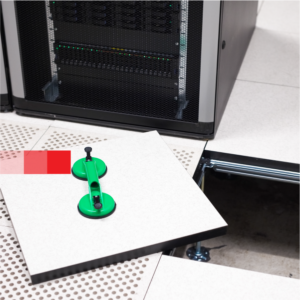 Hospital network security strategies typically begin at Layer 2 and above: VLANs segment clinical traffic from guest access, firewalls enforce policy between zones, and identity platforms control who reaches what. These controls align with HIPAA Security Rule requirements under §164.312 (technical safeguards) and are essential for protecting ePHI across clinical, imaging, and administrative networks.
But HIPAA also imposes physical safeguard requirements under §164.310. Covered entities must implement policies and procedures to limit physical access to electronic information systems and the facilities in which they are housed. That obligation extends to the fiber infrastructure connecting those systems — the patch panels inside MEP rooms, IDFs, and cross-connect spaces that carry traffic between clinical departments, data centers, and building systems.
In practice, hospital fiber management in these spaces is often handled through traditional optical distribution frames. When network paths need to change — during maintenance windows, capacity expansions, or fault isolation — technicians physically move patch cords. That process introduces several risks that conflict with the control expectations of a zero-trust architecture:
- Uncontrolled physical access to critical optical infrastructure
- Inconsistent or missing documentation of connection changes
- Slow mean-time-to-restore (MTTR) during fiber-related outages
- No verifiable record of who changed what, and when
In environments governed by Joint Commission environment-of-care standards and where network uptime directly affects patient safety, those risks create a measurable compliance and operational exposure.
What zero-trust fiber access means in practice
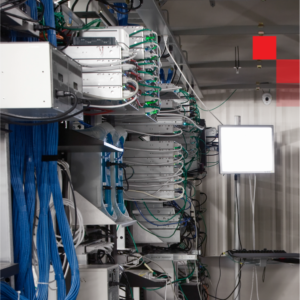 Zero-trust at Layer 0 means removing ad-hoc physical actions from fiber management and replacing them with software-governed workflows. Instead of dispatching a technician to re-patch fibers, hospitals deploy robotic optical switching platforms that create, modify, or remove fiber connections electronically.
In a zero-trust fiber model:
- Connection changes execute through authenticated, role-based software access
- Operations follow configurable approval workflows before execution
- Every connect and disconnect event is logged with timestamp, operator ID, and port-pair detail
- Administrators enforce granular permissions — separating who can view topology from who can modify paths
The CSOS platform provides this capability through a management interface that supports both direct dashboard control and northbound API integration. Operators can provision or modify fiber paths from a topology-aware view while maintaining a full audit trail exportable to SIEM, log management, or compliance reporting systems.
This approach converts fiber patching from an untracked manual activity into a policy-controlled infrastructure operation — consistent with the zero-trust principle that every action requires verification, regardless of where in the network it occurs.
Visibility and auditability for HIPAA-aligned infrastructure
Hospitals operating under HIPAA’s physical and technical safeguard requirements need more than connectivity. They need traceability that withstands audit scrutiny.
When a clinical network segment changes — whether for planned migration, emergency failover, or troubleshooting — infrastructure teams must answer specific questions:
- What optical path is currently carrying this traffic?
- When was the last connection change made on this port pair?
- Who initiated the change, and was it approved?
- Did the change trigger any optical power alarms?
Software-controlled Layer 0 infrastructure answers these questions natively. The management platform maintains topology-aware views of all fiber connections, and every state change generates an auditable event. OTDR-level optical monitoring can detect signal degradation, unexpected loss events, or unauthorized physical disturbance on fiber paths — and these alarms can integrate with building management systems (BMS) and network operations center dashboards.
This HIPAA-compliant Layer 0 automation transforms the fiber layer from a static, unmonitored infrastructure component into an observable, governable part of the hospital network environment — aligned with the same compliance expectations applied to every layer above it.
Resilience: power-fail safe link behavior
 Security and compliance are only part of the requirement. Hospital networks supporting real-time imaging (PACS, radiology), clinical applications (EHR, telemetry), and building operations (HVAC, fire/life safety) must remain operational during facility-level disruptions.
Fiber switching platforms designed for critical infrastructure environments address this through two hardware-level behaviors:
Passive latching switching mechanisms maintain established optical paths without requiring continuous power. Once a connection is made, the optical path persists mechanically — delivering a power-fail safe link that keeps traffic flowing even during a complete power loss event.
Super-capacitor assisted power protection allows the CSOS system to complete any in-progress switching operation during a sudden power interruption, then hold all existing connections in their current state. Unlike battery-dependent systems, super-capacitors deliver predictable energy storage behavior without degradation over the equipment lifecycle.
These characteristics align with resilience expectations defined in TIA-942 (telecommunications infrastructure for data centers), NFPA 99 (healthcare facilities), and BICSI 002 (data center design) — standards commonly referenced in hospital infrastructure specifications.
Why Layer 0 belongs in the hospital zero-trust model
Hospitals increasingly treat their networks as critical infrastructure, applying stronger identity controls, continuous monitoring, and micro-segmentation across every accessible layer. But if fiber connectivity inside MEP rooms still depends on manual patching with no audit trail, the physical network layer remains the weakest link in an otherwise governed architecture.
Extending zero-trust to healthcare fiber infrastructure delivers measurable improvements:
- Fewer unmanaged physical touchpoints in sensitive spaces
- Stronger change control with approval workflows and role-based access
- Clear, exportable audit trails for every network modification
- Faster, policy-driven connection recovery — reducing MTTR from hours to under 60 seconds
The CSOS robotic cross-connect platform brings these capabilities to hospital MEP rooms and cross-connect spaces, closing the Layer 0 gap that manual patching leaves open.
For hospitals building toward a fully governed network architecture, the path forward starts where most security strategies stop — at the physical fiber layer.
Bring zero-trust to your hospital’s fiber layer
XENOptics’ CSOS robotic cross-connect platform replaces manual patching with software-governed fiber switching — delivering audit-ready Layer 0 infrastructure for healthcare environments.
→ Download the CSOS datasheet to review switching specifications, port configurations, and integration capabilities.
→ Schedule a consultation with our engineering team to discuss your facility’s fiber infrastructure requirements.