
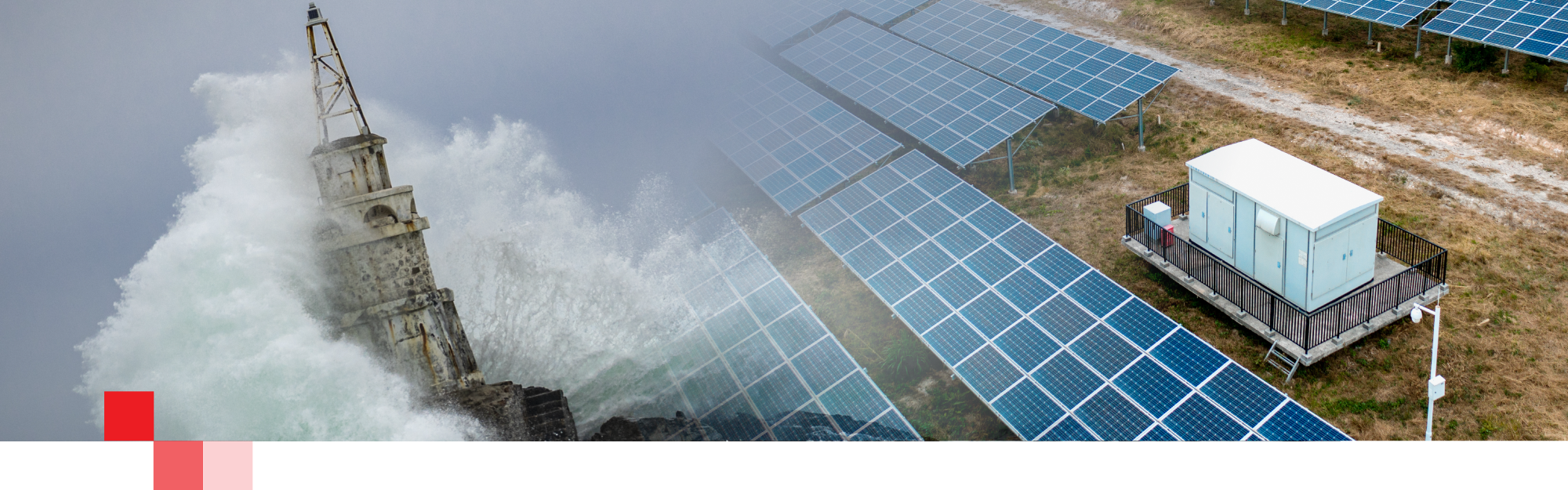
The ferry leaves tomorrow. The storm is arriving tonight. And somewhere between the control building and inverter row 14, a fiber link just went dark.
This is the operational reality for island microgrids and remote solar farms: when fiber fails, you lose SCADA visibility, protection signaling slows, and curtailment decisions get made blind. The failure modes are predictable—cabinet power loss, fiber cuts from debris, a mis-patch from last month’s maintenance, undocumented spurs that nobody can trace.
This post covers how to design fiber redundancy you can actually operate remotely: faster path recovery, fewer dispatches, and an audit trail when regulators ask what happened.
Why Renewables Break Differently
 Island microgrids and remote solar farms share a topology problem: long fiber spurs radiating outward to inverters, weather stations, combiner boxes, and substation interfaces. A utility-scale solar array might span 2–3 kilometers with dozens of monitoring points.
When a fiber segment fails, the impact cascades. Renewable SCADA loses visibility into generation capacity. Protection coordination slows because relay-to-relay communication drops. Operators curtail output preemptively because they can’t confirm grid conditions.
The human constraint compounds the technical one. Island sites have limited technicians—often one or two for an entire facility. Travel depends on weather, ferry schedules, or helicopter availability. Dispatching someone during a cyclone isn’t just expensive; it’s unsafe.
Design the Fiber Plant Like a Ring, Operate It Like Software
The standard answer to single-point-of-failure risk is ring redundancy: two diverse fiber paths connecting critical nodes so traffic can reroute if one segment fails. Most SCADA architects understand this at the protocol level (IEC 61850 PRP/HSR, redundant Modbus gateways). Fewer extend the same thinking to Layer 0—the physical fiber cross-connect.
A passive-power optical switch makes ring redundancy operationally useful. The key characteristic: connections require power to change state, not to hold service. Once established, paths remain stable through outages, brownouts, and battery-saver modes. No power, no problem—traffic flows on the last-configured route.
The operational workflow:
- Detect: monitoring flags loss of light on primary path
- Switch: operator triggers crossover to secondary path remotely (36–60 seconds)
- Confirm: link-up validation shows protected device back online
- Log: timestamped record for compliance and post-event review
Cyclone-Proof Fiber Cross-Connect: What to Look For
If the switching hardware fails in the same storm that took out the fiber, you’ve gained nothing. Equipment for island microgrids needs to survive the environment.
- Environmental tolerance: Units rated for street-cabinet deployment, −40°C to +65°C operating range, sealed enclosures with appropriate IP ratings for salt spray and dust.
- Low standby power: Remote cabinets run on solar/battery with limited reserves. A low-power sleep mode around 0.1W prevents the switch from draining backup power while idle.
- Field-replaceable modules: Hot-swap components let a generalist technician swap parts without splicing tools or taking the unit offline.
- Shock and vibration: Sites near shorelines or seismic zones benefit from GR-63-CORE certification.
Zero-Touch Fiber Monitoring Without New Mystery Boxes
 “Zero-touch fiber monitoring” doesn’t require another proprietary platform. It means using remote switching to enable diagnostics with equipment you already own.
The practical technique: OTDR solar array loop. Configure the cross-connect to create a loopback path from the control building through a fiber segment and back. Your existing OTDR can now characterize that segment remotely—no technician at the far end. Run periodic traces after storms. Compare against baseline. Identify degradation before it becomes an outage.
The switching layer enables faster isolation and reroute. Diagnostics come from your existing stack—OTDR, optical power meters, SCADA alarming—through standard interfaces (SNMP, REST API, dry-contact alarms).
A Simple Deployment Pattern
Start where fiber converges and truck rolls hurt most:
- Control building: central cross-connect for outbound spurs
- Inverter combiner hubs: where string-level fibers aggregate
- Substation interface hut: interconnection with utility or grid operator
- Shoreline landing: for sites with submarine cable or microwave backhaul
Start with one remote hub, prove the MTTR reduction on the next weather event, then replicate as capital cycles allow.
Next Steps
If your island microgrid or remote solar farm still relies on truck rolls to restore fiber paths, map the segments where a single cut blinds renewable SCADA or breaks protection coordination.
Send us your single-line diagram and fiber map—we’ll mark where remote cross-connect reduces dispatches and strengthens ring redundancy.