

Airport perimeter surveillance fails at the fiber layer long before anyone calls it a camera problem. A perimeter intrusion detection system (PIDS), as defined under ASTM E2747 (Standard Specification for Perimeter Intrusion Detection Systems), depends on stable transport across long fence lines, exposed ducts, roadside cabinets, and distributed field devices. When a fiber segment is cut, manually repatched, or taken down for maintenance, the real risk is not just packet loss. It is delayed response, blind zones, and slower restoration of security coverage.
That is why airport security fiber should be designed as a resilience layer, not just a transport medium. ICAO Annex 17 (Security — Safeguarding International Civil Aviation) establishes the framework for airport security, including the requirement for continuous surveillance of perimeter boundaries. Meeting that requirement at the physical layer means keeping critical links available, making path changes controllable, and giving operators a clear view of what is connected, what changed, and what needs attention. That outcome aligns closely with our Layer 0 model of remote non-blocking switching, passive latching, and centralized management rather than manual patch-panel dependency.
Why perimeter surveillance needs fiber resilience
 Airport perimeters are operationally different from ordinary building networks. The routes are longer. Exposure is higher. Access is slower. In a representative layout — an 8 km perimeter with 12 to 16 field cabinets serving four to six surveillance zones — a single duct cut can isolate three or four zones simultaneously, affecting camera feeds, vibration sensor network segments, and zone controllers at once. In that setting, perimeter surveillance design needs more than spare strands. It needs a practical way to reroute connectivity without waiting for a manual cross-connect in the field.
Our platforms — including the CSOS-72/144 and XSOS-288 — are built around remote, automated replacement of manual ODF and patch-panel operations through non-blocking robotic fiber switching. In plain terms, that means the fiber path can be changed under software control instead of dispatching someone to move jumpers by hand. For security operations, that matters because it reduces recovery friction during faults, construction damage, or controlled maintenance windows.
Where automatic fiber reroute fits
In an airport perimeter surveillance architecture, automatic fiber reroute should sit between the field sensing layer and the broader security operations stack. Cameras, perimeter intrusion detection devices, and zone controllers still generate the alarm or video event. The fiber layer determines whether those signals keep moving when a path degrades or fails. This layered approach is consistent with the defense-in-depth principles described in ASIS International’s Perimeter Security guidelines, where each layer of protection operates independently so that failure at one layer does not cascade to adjacent systems.
Our resilience architecture uses passively latched any-to-any matrices, meaning broken or congested circuits can be rerouted remotely (per the CSOS-72/144 technical brief). The same architecture ensures power-loss survival through latching: established circuits remain active if mains or UPS power is lost. For perimeter infrastructure, that is the important idea — preserve the live connection state and give operators a controlled alternate path instead of forcing a manual rebuild in the middle of an incident.
Redundant ring design for PIDS transport
A redundant ring is one of the clearest ways to think about airport security fiber. One route carries the normal perimeter surveillance load. A second path exists so the network can maintain service when the first path is damaged or intentionally isolated. The ring does not remove the need for good physical routing — and IEC 62676-1-1 (Video surveillance systems for use in security applications) provides relevant guidance on transmission path requirements for security video — but it gives the perimeter a second way around the problem.
This is where remote non-blocking switching becomes useful. Instead of treating the ring as static insurance, operators can treat it as an operational tool. If one segment is impaired, the optical path can be reworked remotely. Our NMS/EMS platform also supports synchronized database awareness and auto-discovery, which helps keep the operational view aligned with the live plant. That matters in perimeter environments, where stale records and manual patching history can slow recovery.
Remote health check and OTDR perimeter loop context
Remote health check is equally important. Operators need to know whether a perimeter route is healthy before an incident, not only after a break. Our NMS supports real-time visibility, topology creation, interconnection management, ordered task execution, and operation logs for troubleshooting and audit (per the NMS datasheet). In an airport perimeter setting, those capabilities support a more disciplined change process around surveillance transport, aligned with the continuous monitoring expectations set out in ICAO Annex 17.
For OTDR perimeter loop planning, caution matters. Based on our published MSOS specifications, integrated OTDR support is available for remote troubleshooting, with optional OTDR interfaces and chaining support. That is relevant as proof that OTDR-aware remote fault localization exists within the broader portfolio, but it should not be assumed as a standard feature of every deployment. It is better framed as a design option where remote fault localization is part of the surveillance transport strategy. Deployments requiring OTDR integration should be scoped with our engineering team during design review.
Operational control at Layer 0
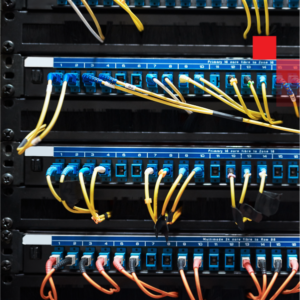 The biggest shift is operational. A resilient PIDS system is not only about diverse paths. It is about controlled workflows. Our NMS provides topology views, connection and disconnection operations, ordered task queue execution, audit-friendly logs, and remote authentication options including RADIUS, TACACS+, and LDAP. That combination supports perimeter change control that is easier to verify and harder to mishandle. The switching hardware itself is designed for installation in secured telecommunications rooms or equipment shelters — not field cabinets — keeping the control plane inside the airport’s physical security boundary.
For airport operators, the design question becomes practical: if a fiber segment is lost at the perimeter, can the team reroute remotely, confirm the new path in software, and preserve service continuity without manual repatching? If the answer is yes, the surveillance network is operating more like critical infrastructure and less like a patchwork of field fixes.
In short, airport perimeter surveillance fiber should be engineered for continuity, remote control, and visible recovery. That is the real value of Layer 0 resilience in a PIDS environment.
Next steps
For engineers and system designers: Explore the CSOS-72/144 and XSOS-288 platform specifications, or download the NMS datasheet for detailed capability mapping against your perimeter surveillance transport requirements.
For procurement and security program managers: Contact our team to discuss reference architectures for airport perimeter fiber resilience, including redundant ring design options and NMS integration scoping.