

Why the fiber layer becomes a 6G problem
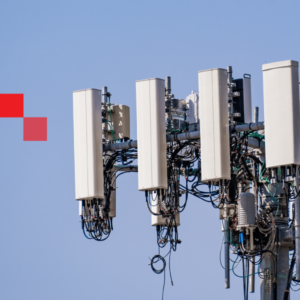 6G is still pre-standard. The ITU-R IMT-2030 framework sets the high-level capability targets, and 3GPP is expected to begin normative 6G specification work in Release 20, with commercial deployments anticipated in the 2028–2030 window. None of that changes the physical layer reality: whatever 6G looks like commercially, it will run over fiber, and that fiber has to be operationally controllable.
The architectural pressure is already visible in the work coming out of O-RAN ALLIANCE WG9 (Open X-haul Transport) and ETSI’s Zero-touch network and Service Management group (ETSI ZSM). Both point in the same direction — denser radio sites, disaggregated RAN functions, edge compute pushed closer to the user, and transport that has to flex on demand. That direction makes the static fiber patching model a bottleneck.
This is where a compact Layer 0 automation module such as XENOptics CSOS becomes relevant. CSOS is a compact smart optical switch designed for remote automated optical patching and non-blocking fiber cross-connect switching. It gives operators a way to change optical paths from a control system instead of dispatching a technician to move jumpers at a tower cabinet, edge hut, central office, or aggregation site.
The 6G tower challenge
A 6G site will need to terminate more than a 5G site does today. Following the O-RAN disaggregation model — Radio Unit (RU), Distributed Unit (DU), Centralized Unit (CU) — and the x-haul transport split (fronthaul, midhaul, backhaul) defined in O-RAN WG9, a single tower may need to connect:
- Multiple radio units across sub-6 GHz, mmWave, and potentially sub-THz bands
- Local DU resources for latency-sensitive functions
- Edge compute supporting URLLC and AI-RAN workloads
- IEEE 1588v2 / SyncE timing distribution
- OAM and monitoring telemetry
- Two or more transport paths for protection and load balancing
That creates a Layer 0 problem. The radio and packet layers are becoming dynamic — O-RAN’s RIC framework (RT-RIC and Non-RT-RIC) explicitly assumes runtime reconfiguration. The fiber layer underneath them remains static. When a path must be changed, repaired, isolated, or tested, the process still depends on manual patching.
For dense 6G deployments, that model does not scale. Tower and edge locations are remote, space-constrained, and expensive to visit. Dispatch-based fiber operations slow restoration, increase human error risk, and make change control harder to enforce. ETSI ZSM-002 frames this gap directly: full-stack automation requires automation at every layer, including the physical one.
Where CSOS fits
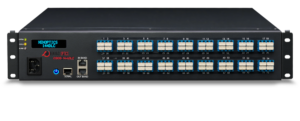 CSOS acts as a compact optical switching layer between tower-side fiber assets and upstream transport. It sits in a tower cabinet, street cabinet, local edge facility, aggregation node, or central office connection point.
Its role is not to replace the radio network or the transport equipment. Its role is to make the physical fiber paths controllable from the same orchestration layer that already manages everything above Layer 0.
In a 6G tower context, CSOS supports operations such as:
- Moving a tower link from a primary path to an alternate route
- Reassigning fiber between radio, edge, and aggregation resources as workloads shift
- Supporting planned maintenance without manual repatching
- Isolating a degraded path from the NOC
- Restoring service through a pre-planned protection route
The value is operational. CSOS brings remote provisioning and automated configuration to physical fiber connections, using robotic non-blocking optical switching and the XENOptics 3D-OS topology.
Why this matters for remote sites
Most tower and edge sites have no resident fiber technician. When a physical path needs attention, the operator has to detect the issue, open a ticket, dispatch a technician, gain site access, identify the correct fiber, and complete the patch under time pressure. That workflow is slow and error-prone, and the failure modes — wrong-port patches, dirty connectors, contamination during reseating — show up consistently in BICSI fiber operations guidance and TIA-568 maintenance practice.
CSOS changes the operating model. Physical-layer switching is executed remotely. For 6G tower architecture, that means fiber changes become part of a controlled NOC workflow rather than a field-only task.
CSOS also supports passive latching, which maintains provisioned traffic during power failure and field replacement. That matters in tower and edge environments where power conditions and maintenance access are less predictable than in a core facility. The CSOS product line includes a ruggedized OSP variant rated for street cabinet deployment, which is directly relevant to the small-cell densification implied by IMT-2030 capability targets.
Technical proof points
For engineers, the case has to be grounded in optical and operational detail. The figures below are taken from XENOptics CSOS product documentation and should be confirmed against the current datasheet for any specific deployment.
| Parameter | Typical |
|---|---|
| Switching time | 36 s |
| Insertion loss (connectorized) | 0.5 dB |
| Return loss — UPC | -55 dB |
| Return loss — APC | -65 dB |
| Standby power | 6 W |
| Sleep-mode power | 0.1–0.5 W |
| Operating range — indoor | -5 °C to 45 °C |
| Operating range — OSP / street cabinet | -40 °C to 65 °C |
These numbers do not make CSOS a “6G-certified” product — no such certification exists, since 6G specifications themselves are not finalized. They establish CSOS as a practical Layer 0 building block for architectures where compact, remotely controlled optical switching is required, with optical performance compatible with current and foreseeable x-haul wavelengths.
Management and control
CSOS supports management through web GUI, local terminal CLI, EMS, and NMS interfaces.
For a 6G tower environment, the meaningful integration is into a broader orchestration workflow rather than standalone management. The XENOptics EMS handles connectivity operations, scheduling, rollback, monitoring, logs, alarms, SNMP, REST, SMTP, and Syslog. A REST-driven EMS aligns naturally with the closed-loop automation model described in ETSI ZSM-002 and with the service management and orchestration (SMO) layer defined in O-RAN architecture.
One operational caveat: CSOS and MSOS reference EMS-driven management workflows, but cross-family compatibility should be validated per release rather than assumed.
Make Layer 0 ready for 6G
6G tower architecture will need more than new radios and new spectrum. It will need fiber infrastructure that adapts without sending people to every cabinet, hut, and tower site.
CSOS gives operators a compact way to automate physical fiber switching at the edge of the network. Deployed deliberately, it converts tower fiber from a static patching layer into a remotely controlled operational asset — and brings the physical layer into line with the automation expectations that 3GPP, O-RAN, and ETSI are already setting for everything above it.