
Broadcast operations depend on predictable fiber paths. When storms, fiber cuts, or cyber incidents break those paths, newsrooms and emergency comms teams must recover fast. Field dispatch is slow and often unsafe in these conditions. Modern response teams are shifting toward mobile disaster recovery pods—self-contained units that replicate a mini studio, uplink node, and routing core.
These pods become dramatically more effective when their fiber layer is automated. XENOptics platforms such as XSOS for high-density switching and CSOS for compact or outdoor deployments deliver remote, zero-touch operations. Each connection or change completes in 36–60 seconds, eliminating manual patching during a crisis.
Why Broadcasters Need Mobile, Self-Contained DR Pods
Outages rarely occur where access is easy. A newsroom may lose its long-haul path during a storm; a stadium may suffer a cut during a live event; or a cyber incident may isolate a master control room. If continuity depends on sending field technicians into unstable areas to rebuild routing, recovery becomes slow and unpredictable.
A DR pod removes that dependency. It offers:
- A mobile setup for ingest, monitoring, and routing
- Multiple uplink options
- Autonomous power
- Automated switching that restores paths without physical intervention
When placed at any surviving access point, the pod can resume contribution and distribution flows in minutes.
Inside a Modern Broadcast DR Pod
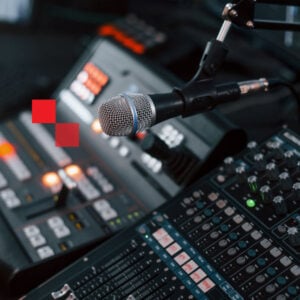 A DR pod typically acts as a mobile studio, network hub, and emergency communications node. Common elements include:
- SDI, HDMI, and IP ingest
- Fiber breakout for SDI/HDMI
- Local monitoring
- Satellite, microwave, or bonded cellular uplink
- Generator + battery support
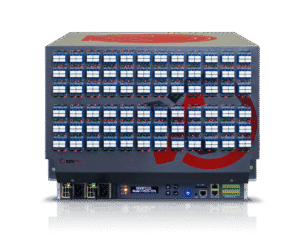
To handle routing under pressure, the pod integrates a robotic switching platform—either CSOS-72/144 for compact designs or an XSOS chassis for higher-density loads.
Why CSOS fits DR pods
The CSOS-72S and CSOS-144D support OSP conditions (−40 °C to +65 °C) and maintain uniform insertion loss with a passive latching mechanism that keeps traffic flowing during power loss. Each switching action completes in 36–60 seconds, even under harsh conditions, making it ideal for trailer-mounted DR pods.
Why XSOS fits larger broadcast deployments
Where more fiber paths are needed—such as regional networks or event pods—XSOS offers greater density with similarly rapid switching (36–60 seconds) and passive latching that maintains stability during generator transitions. XSOS consumes power only when switching, with low standby draw, making it efficient for temporary deployments.
Automation as the Disaster-Recovery Multiplier
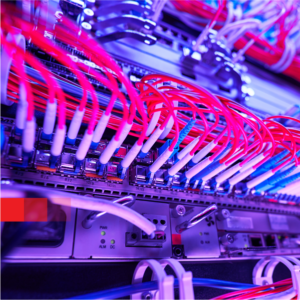 Manual fiber patching introduces risk at the worst possible moment. Poor visibility, weather, and physical hazards increase error likelihood.
Automated switching solves this by enabling:
- Remote re-routing through NMS or EMS
- Full task logging and sequencing
- Predictable switching (36–60 seconds) for each connection
- Passive-latch continuity during outages or generator changeover
- No need for field technicians in hazardous zones
With automation, the DR pod performs like a controlled facility—regardless of where it is deployed.
Practical Use Case: Regional News Network Recovery
Scenario
A regional broadcaster loses its primary fiber backhaul during a severe storm. Flooding prevents technicians from reaching the damaged segment.
DR Pod Response
- A trailer-mounted pod is placed at a surviving splice location.
- Inside the pod, a CSOS-144D handles local routing.
- The NOC connects remotely through out-of-band management.
- A new chain is built: newsroom → pod → uplink → MCR.
- Required cross-connects execute in 36–60 seconds each.
- Passive latching preserves all optical paths when the generator cycles.
Outcome
The newsroom is live again in minutes, without dispatching a single technician into the field.
Trailer-Mounted Robotic ODF for Harsh Conditions
DR pods often face unstable environments: vibration, dust, heat, or intermittent power. CSOS units are engineered for these conditions, with environmental ratings up to +65 °C, mechanical latching, and consistent optical performance. XSOS platforms add higher port counts and energy-efficient operation (6 W standby), ideal for generator-powered or battery-backed deployments.
Both platforms maintain connection state during power interruptions, a critical requirement for mobile DR.
What to Consider When Designing a DR Pod
- Match switch density to operational scope (CSOS vs. XSOS)
- Design a clear east–west fiber architecture
- Use ruggedized enclosures and structured cable management
- Integrate NMS oversight for topology and queued tasks
- Run scheduled failover simulations to validate switching and power stability
These elements ensure the pod behaves like a trustworthy extension of primary broadcast infrastructure.
Outcome: Faster Recovery, Lower Risk, Higher Uptime
A disaster recovery pod equipped with XENOptics switching delivers a predictable, repeatable method of restoring broadcast continuity. With automated routing and 36–60 second switching, teams regain control faster, reduce operational risk, and remain on air when primary infrastructure is compromised.
Book a Demo or Explore Deployment Patterns
If your team is evaluating DR pod strategies or upgrading continuity plans, you can book a demo to see how XSOS and CSOS platforms support rapid-response broadcast operations.