

As telecommunications networks evolve to support 5G densification and FTTx expansion, manual fiber management has become a critical bottleneck. Robotic fiber switching technology enables automated, software-defined control of physical fiber connections, reducing service activation times from days to minutes while eliminating human error. This comprehensive guide explores how 5G fiber backhaul switches and FTTH robotic optical switches are revolutionizing network operations through open-access automation, delivering measurable ROI through reduced operational costs and improved service reliability. Our XSOS, MSOS, and CSOS platforms provide scalable solutions tailored to different network deployment scenarios.
The transition to 5G networks represents an unprecedented challenge in fiber infrastructure management. According to industry projections, global 5G small cell deployments will reach 13.1 million by 2025, with each cell requiring dedicated fiber backhaul connections. This exponential growth in fiber density creates several critical operational challenges:
Traditional manual patching methods, which require technicians to physically connect fiber cables at optical distribution frames (ODFs), simply cannot scale to meet these demands.
Studies show that manual fiber patching errors cost operators an estimated $2.5 billion annually in truck rolls, service delays, and SLA penalties.
Robotic fiber switching systems represent a paradigm shift in physical layer management. These intelligent systems combine precision robotics with software-defined networking (SDN) principles to enable remote, automated control of fiber connections.
Technical Architecture Components:
Modern robotic fiber switches deliver enterprise-grade performance with minimal power consumption:
| Specification | Performance Metric |
|---|---|
| Port Density | 384-1,152 ports per chassis |
| Switching Speed | <30 seconds per connection |
| Insertion Loss | <0.5 dB typical |
| Return Loss | <-50 dB |
| Wavelength Range | 1260-1650 nm |
| Power Consumption | 6W standby, <0.5W deep sleep |
| Operating Temperature | -40°C to +85°C |
| MTBF | >200,000 hours |
| Availability | 99.999% (five nines) |
The integration of robotic switching with zero-touch provisioning enables complete automation of the fiber provisioning lifecycle:
The implementation of 5G fiber backhaul switches addresses the unique requirements of next-generation mobile networks. These systems enable dynamic allocation of fiber resources to support network slicing, allowing operators to create multiple virtual networks with distinct performance characteristics over shared infrastructure.
Critical 5G Backhaul Capabilities
Real-world deployments demonstrate significant operational improvements. A tier-1 operator in Asia Pacific reduced 5G cell site activation time by 87% after implementing robotic fiber switching, while simultaneously reducing connection errors to less than 0.1%.

Real-world deployments demonstrate significant operational improvements. A tier-1 operator in Asia Pacific reduced 5G cell site activation time by 87% after implementing robotic fiber switching, while simultaneously reducing connection errors to less than 0.1%.
FTTH robotic optical switches revolutionize residential fiber deployment by enabling remote service activation without truck rolls. This technology is particularly valuable for operators managing large-scale fiber-to-the-home networks where manual intervention at distribution points is costly and time-consuming.
Open-access automation through robotic switching enables multiple service providers to share physical fiber infrastructure while maintaining complete service isolation.
This capability is essential for regulatory compliance in markets requiring infrastructure sharing and for maximizing return on fiber investments.
The convergence of 5G and edge computing requires unprecedented flexibility in fiber connectivity. MEC hub integration with robotic switching enables dynamic routing of traffic between cell sites and distributed compute resources, supporting latency-sensitive applications like autonomous vehicles and augmented reality.
Advanced wavelength management capabilities enable operators to maximize fiber capacity through intelligent optical layer automation:
SLA-driven turn-ups transform service delivery by automating the entire provisioning process based on contractual requirements:
Operational Efficiency Metrics. Organizations implementing robotic fiber switching report substantial operational improvements:
| Metric | Before Implementation | After Implementation | Improvement |
|---|---|---|---|
| Service Activation Time | 3-5 days | <1 hour | 95% reduction |
| Manual Patching Errors | 15-20% | <0.1% | 99.5% reduction |
| Technician Productivity | 8 patches/day | N/A (automated) | 100% automation |
| Documentation Accuracy | 70% | 100% | 43% improvement |
| Mean Time to Repair | 4 hours | 15 minutes | 94% reduction |
The transition to robotic switching delivers significant sustainability benefits:
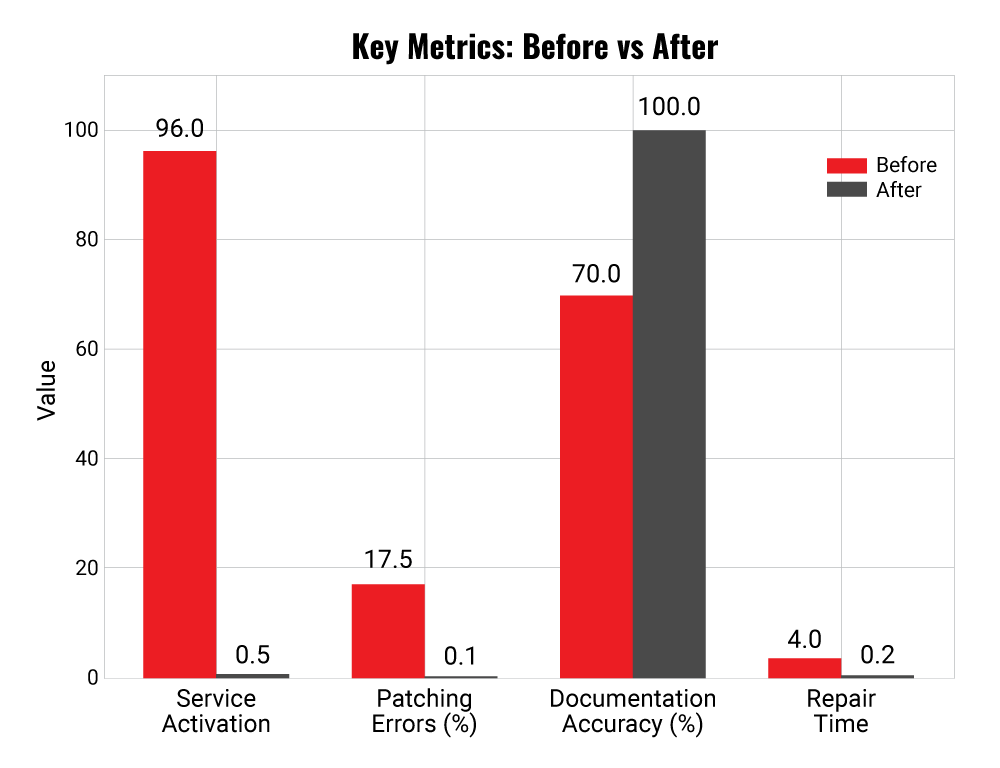
Chart 1

Chart 2
A leading European telecommunications provider deployed robotic fiber switching across 50 central offices to support their 5G rollout and FTTH expansion. The implementation delivered remarkable results:
The evolution of robotic fiber switching continues with several emerging capabilities:

Robotic fiber switching represents a fundamental transformation in how operators manage physical layer infrastructure. By automating fiber connections through 5G fiber backhaul switches and FTTH robotic optical switches, operators can dramatically reduce operational costs while improving service quality and agility. The integration of open-access automation capabilities ensures these systems can support diverse business models and regulatory requirements.
As networks continue to densify to support 5G, IoT, and edge computing applications, the ability to dynamically manage fiber resources becomes not just an operational advantage but a competitive necessity. Organizations that embrace robotic fiber switching today position themselves to efficiently scale their networks while maintaining the flexibility to adapt to future technological advances.
The combination of proven ROI, operational benefits, and future-ready capabilities makes robotic fiber switching an essential component of modern telecommunications infrastructure. With continued advances in automation, AI integration, and optical technologies, these systems will play an increasingly critical role in enabling the connected future.
For more information on implementing robotic fiber switching in your network, including detailed technical specifications and ROI calculations, contact our solutions engineering team.
© 2018-2026 XENOptics. All Rights Reserved. Terms of Use.