

Network slicing makes 5G services flexible. But it does not remove the physical work of changing fiber paths. When you need to reassign, restore, or provision a transport route between core, metro, and edge, manual ODF and patch-panel work still slows everything down.
That is exactly where our 5G fiber automation helps.
Our XSOS-576D provides robotic optical cross-connect switching, together with topology-aware management and software-driven control. It is built for central offices and edge locations. Our NMS and EMS add the dashboards, connection workflows, scheduling, rollback, logging, and RESTful interfaces you need at Layer 0.
Network slicing (3GPP TS 28.541) defines logical transport slices. The actual route still depends on real optical paths. Every time you stand up a new path, restore service after a fault, shift traffic to an edge site, or change a protected route, the fiber layer becomes part of your delivery timeline.
If that layer still needs manual patching, your service agility is limited by truck rolls, room access, and human coordination.
Our XSOS-576D is a remote, non-blocking robotic switch with 576 ports ((144×2)×(144×2)). It uses a patented 3D-OS fabric and passive latching. This keeps traffic alive during power loss and field replacement. It also has a built-in super-capacitor UPS that finishes any in-progress move before the system goes into safe latching mode.
Key benefits for 5G operators:
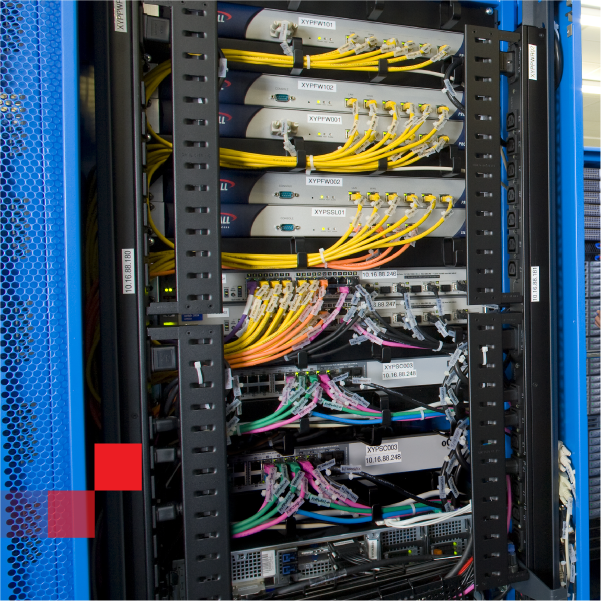
Hardware alone is not enough. Our NMS gives you a real-time dashboard mapped to your actual topology. You can add background images, units, and virtual patch panels. It shows alarm summaries, port status, and inventory. When you need to connect ports, the system calculates the shortest path and queues the task.
Our EMS handles the execution:
All operations are queued, time-stamped, and logged. You can enforce four-eyes approval and feed immutable logs to your SIEM.
Municipal networks succeed or fail based on how they handle multi-tenant operations. The hard part is not the fiber itself. The hard part is avoiding conflicts when multiple ISPs share physical infrastructure.
A robust multi-ISP fiber routing model uses four controls:
Port allocation by tenant. Assign port pools per ISP or per service class. Reserve dedicated resources for municipal critical services (traffic management, public safety backhaul, SCADA connectivity).
Tenant-scoped permissions. Each ISP creates connections only within its allocated ports. Any action affecting shared trunks or inter-tenant boundaries requires operator-level approval.
Standard handoff patterns. Define repeatable handoff templates for common service types—residential GPON, business Ethernet, point-to-point wavelength services. Templated handoffs reduce one-off design decisions that introduce patching errors.
Evidence by default. Log every action. Treat the audit log as a deliverable product you provide to ISPs as part of the wholesale service, not as an internal-only record.
When these controls are implemented, a municipality can support rapid provider changes without dispatching technicians to cabinets. In mature workflows, routine service activation targets completion in under 50 seconds because the work becomes "select route → approve → execute," not "schedule site access → drive → patch → label → verify."
| Parameter | Value |
|---|---|
| Port configuration | 576-port non-blocking ((144×2)×(144×2)) |
| Switching time | 35 s typical · 60 s maximum |
| Connectorized insertion loss | 0.5 dB typical · 1.0 dB maximum |
| Return loss | -55 dB (UPC) · -65 dB (APC) |
| Insertion-loss repeatability | 0.06 dB typical · 0.1 dB maximum |
| Power-loss protection | Passive latching + super-capacitor UPS |
| Termination options | Spliced and LC duplex connectorized |
| Indoor operating temperature | -5 °C to +45 °C |
| Standards compliance | ETSI 300019 Class 3.2 · NEBS 3 · GR-63-CORE |
Passive latching means established circuits stay up even if mains or UPS power fails. This is built-in resilience for 5G transport.
You decide who can make changes, how they are approved, and what record remains. NMS supports local login plus RADIUS, TACACS+, and LDAP. EMS adds firewall rules, web access control, and role-based permissions (Admin / Approver / Operator). Every connect or disconnect is logged and can go straight to your SIEM.
Our XSOS-576D is documented for central offices and edge sites. It meets carrier-grade standards and fits standard 19-inch racks. Engineering case studies show phased deployments in MDF and MMR rooms - perfect for metro interconnects and 5G transport.
Our solution does not replace your logical slicing. It removes the last slow step at Layer 0.
You get:
5G services move at software speed only when the fiber layer can keep up. We give you that speed at Layer 0.
What is Layer 0 automation in 5G transport?
It replaces manual ODF and patch-panel work with remotely controlled robotic fiber switching. Physical paths between core, metro, and edge can be changed through software commands instead of on-site patching.
How does passive latching protect services during power loss?
The switch holds connections mechanically. No continuous power is needed. Our super-capacitor UPS finishes any move in progress before safe latching takes over.
What insertion loss can I expect?
Connectorized version: 0.5 dB typical, 1.0 dB maximum. These are the exact numbers from our datasheet and are suitable for most 5G transport link budgets.
© 2018-2026 XENOptics. All Rights Reserved. Terms of Use.